Saturday, May 30, 2015

Recess Revolution

We are ready for a very exciting June!  During these last two and a half weeks we have many fun and engaging activities planned.  Mark your calendars for the Annual Ethan Allen Dance Festival on the last Tuesday of the school year.  We hope you are able to attend and see the first graders perform the Hukilau.

Please check Friday Folders for a permission slip for Recess Revolution.  You can learn more about it here:  http://www.recessrevolution.org
This event will be on campus, but just like the walkathon a permission slip is required.  It should be a very fun and creative day for the scholars!

Recess Revolution reminds me of one of my favorite quotes:  "Creativity is intelligence having fun."

Thursday, May 14, 2015

QR Codes

We are looking forward to sharing some of our work with you next Tuesday at Open House!  If you have a smart phone,  please download a QR code reader app before Open House.  That way you will be able to easily scan the QR codes I've posted to access your child's Prezi and other scholars' Prezis as well. Very high tech for first grade, I know, but that's the kind of work our children are doing these days believe it or not!  If you don't have a smartphone please don't worry, I will have an iPad available.

Tuesday, May 5, 2015

We are hard at work!

Parents, I am sorry it has been so long since my last post.  As you know our standards have changed this year and I find myself spending lots of time creating new assignments to address Common Core.  I wish I had more time to keep this blog updated!  I do continue to keep our calendar current, and you can see that May is a very busy month for us.  We are working hard to prepare many projects to share with you at Open House, which is just two weeks away on Tuesday, May 19.  We hope you can come to see some of our work which will especially highlight science, geometry, and our writing.


Saturday, February 28, 2015

Number Bonds

I have gotten many questions over the last few days about number bonds.  I can't say that I blame you!  This is a completely different strategy for addition than the way that adults of our generation learned to add, let alone the way that your older children learned to add.  Please keep in mind that this is ONE OF MANY strategies that are presented to the scholars as methods to solve an addition problem.  The thought process behind number bonds is that it builds a strong conceptual understanding of how the groups of tens and ones are combined.  With that said, I fully agree that they are complicated to draw and keep orderly.  My job is to present multiple strategies and make sure that my scholars know how to correctly use the variety of strategies.  When the students take tests they are able to choose the strategies that they prefer.  So while you may see classwork and homework from me asking them to use number bonds, if they prefer to use a different strategy on their test that is perfectly fine!  As long as they understand the process of addition and are able to explain their thinking then our mission is accomplished.


Here are the steps for addition with regrouping:


Student work


 Number bonds for addition without regrouping:


Some of the many other possible strategies that students may choose to use for addition:


More student work


When given a choice, about half of the class chooses to use number bonds to add and half chooses a different strategy.  All scholars are able to find the answer correctly using the strategy of their choice.


First grader scholars think like scientists!

I'm always amazed by the artistic talent and level of details that my scholars possess.  The scholars enjoyed drawing themselves as scientists for their science portfolios.


Universal Theme: Relationships can be Positive or Negative


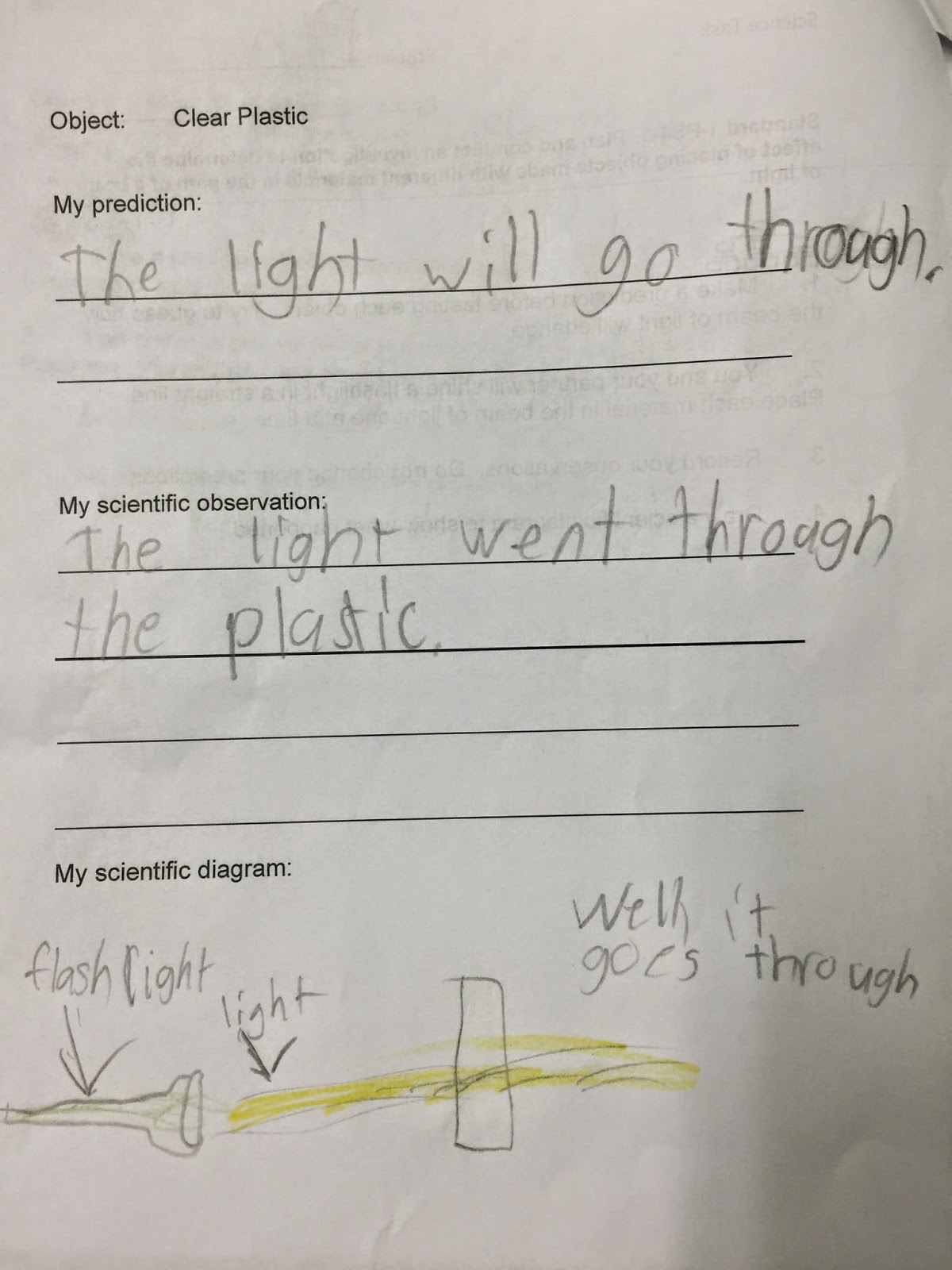
Science Experiment: How do different objects change a beam of light?

One of my favorite things about our new Common Core standards is our all new science standards.  In past years we focused on concepts such as seasons, states of matter, and life cycles.  Our new standards are much more vigorous and I've enjoyed designing these new experiments for my scholars.  Here are some examples from the "lab reports" we completed last Friday.  The scholars observed how the light from a flashlight was changed by clear plastic, wax paper, cardboard, and mirrors.  I was so excited to see several scholars take the initiative to design their own follow up experiments, such as combining two materials or placing the materials in different locations.  The experiment was a big hit!